
The 5 Ps for easy Rose Growing
1. Planting
Plan well in advance of purchasing your rose. Roses come in a multitude of sizes, habits and colours. Consider the eventual size of your rose. Roses prefer a sunny position and neutral/slightly acidic, well-draining soil. Some can tolerate a degree of shade; some will thrive in poor soils. Do your research.
Planting in a pot?
Choose shorter, more compact varieties. Avoid vigorous shrubs and climbers. Tall containers are best, at least 45cm deep. Use a soil-based compost like John Innes No.3. Roses in pots require special attention to feeding and watering (please follow our watering calendar). Replace/ replenish the soil in your pots every 2-3 years. Potted roses do not need to be over-wintered indoors. Please leave outdoors.
2. Preparation
Ensure the area is free from leaf-litter, stones, weeds and other planting – young roses will not tolerate competition from other plants. Soil that has previously grown roses should be removed down to 45cm and replaced with good soil from elsewhere. Deeply dig a hole and add plenty of organic matter, eg. well-rotted manure/garden compost. Do this well in advance to allow the
soil to settle.
3. Planting
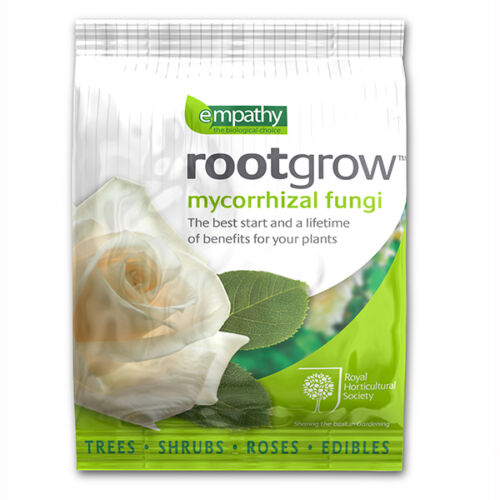
Using mycorrhizal fungi (eg. Rootgrow) when planting, can aid the establishment of roses and help prevent rose replant disease. soil to settle.
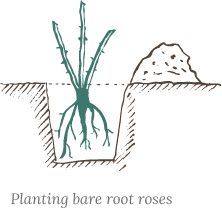
Bare Root Roses are lifted when dormant (November – March). They arrive tied together, sealed in a plastic bag, within a wax-lined paper sack. If conditions are unsuitable for planting immediately (eg. frosty/very wet), leave the sack unopened and sealed in a cool, frost-free place for up to 1 week. When you are ready to plant, open the bag and untie any string. If the roots appear dry, soak in a bucket of water for several hours. Dig a hole large enough to accommodate the roots without cramping, prune lightly if necessary. Then mix a handful of bonemeal or rose fertilizer with the excavated soil. Spread out the roots in the hole and gradually replace the soil, firming well, so the union (where the roots meet the shoots) is 3-4cm below soil level.
Water well.
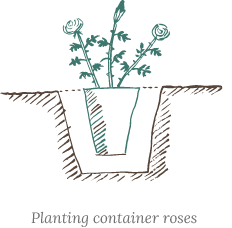
Container Roses can be planted out from June – February. Ensure the compost is moist and the rose is well rooted in the pot before planting.
Do not plant out in spring, while the root ball is developing. Prepare a planting hole 45cm deep x 45cm wide, adding well-rotted organic matter and a handful of bonemeal/rose fertilizer to the soil.
Remove the pot and tease out the outer roots. Place root ball in hole and replace soil, firming well so the union is just below soil level. Water generously.
Climbing and Rambling Roses should be planted at least 45cm away from a structured wall, the canes at a 45° angle.
Hedging: plant at a distance of half the eventual width of the rose or less.
4. Preservation
Roses can be long-lived plants provided they are properly maintained. They require plenty of moisture and nutrients to stay healthy: in dry spells, water well, especially in the first year after planting. Apply a deep mulch (5cm) every spring to retain water and suppress weeds. Feed twice a year on heavy soils (March and June) and more regularly on lighter soils, with a good rose fertiliser (eg. Bonemeal). Dead-head to encourage quicker repeat-flowering: cut just above an outward-facing bud, 2-3 leaves below the spent bloom. Don’t dead-head if you want hips.
Pests and diseases are best prevented by spraying early in the growing season (March/ April), alternating spray products can reduce resistance. Remove damaged/ diseased stems and foliage at the first signs with clean secateurs. Keep the area around your rose free from weeds and leaf-litter to reduce competition for moisture and nutrients.
5. Pruning
Pruning helps maintain productive, balanced and healthy plants. Different rose types require
different strategies.
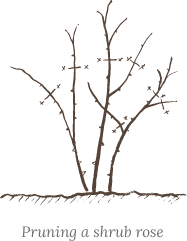
1. Once flowering shrub roses (eg. Species, Alba, Gallica, Centifolia, Damask, Moss etc) flower on old wood and require little pruning until well established. Once established, one or two of the very oldest stems can be removed annually (after flowering in July). Shorten stems by up to a third in spring to tidy and shape the plant.
2. Repeat-flowering shrub roses are best pruned in February/ March. In the first year, prune very lightly, reducing the stems by no more than a third. In subsequent years, growth can be reduced by up to half, to leave a shapely open-centred plant.
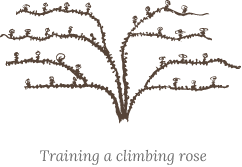
3. Climbing and Rambling roses require tying to a support and training can help them maximise their potential.
Climbing roses generally repeat flower and will produce more flowers if trained horizontally.
Bend and tie in new canes to their supports until they fill the allotted space. Do this in the autumn when the canes are more flexible. If training up pillars and posts, twist the stems around the uprights. Any side shoots that have flowered can be reduced by two-thirds in the spring. Once fully established, remove some of the oldest stems completely in spring to encourage fresh basal growth.
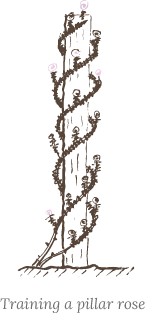
Rambling roses are generally once-flowering and produce flowers on old wood. They only require pruning once fully established or if they have outgrown their allotted space. Remove one or two of the oldest canes completely after flowering. Other growth can be tied in or cut back to keep the plant tidy.
As a general rule across all rose types, any dead, diseased or damaged stems should be removed, along with all over-wintered leaves.